April 17th, 2026
AI Interior Design Statistics: 10 Statistics You Should Know in 2026
The latest data on AI adoption in interior design, virtual staging impact on listings, and how visualization is reshaping decisions for buyers, sellers, and designers.
TL;DR
- The global AI in interior design market was estimated at $3.28 billion in 2025 and is projected to reach $15.0 billion by 2033 Grand View Research
- 31% of design firms already use AI, rising to 50% among firms with 10 or more employees Houzz
- AI-using design firms gain an estimated $74,400 in annual productivity per firm Houzz
- AI use among interior designers tripled to 29% in 2025, up from 9% in 2023 1stDibs
- 71% of designers say AI can boost creativity Kitchen & Bath Design News
- 71% of sellers are more likely to hire an agent who offers virtual tours and/or interactive floor plans Zillow
- 20% of prospective buyers rank 3D/virtual tours as the single most important listing feature Zillow
- 83% of buyers' agents say staging helps buyers visualize a property as a future home National Association of REALTORS
- 31% of buyers are more willing to walk through a home they saw online after seeing it staged National Association of REALTORS
- VR tours shortened property marketing time by 6.4% and narrowed bid-ask spread by 2% Housing Studies
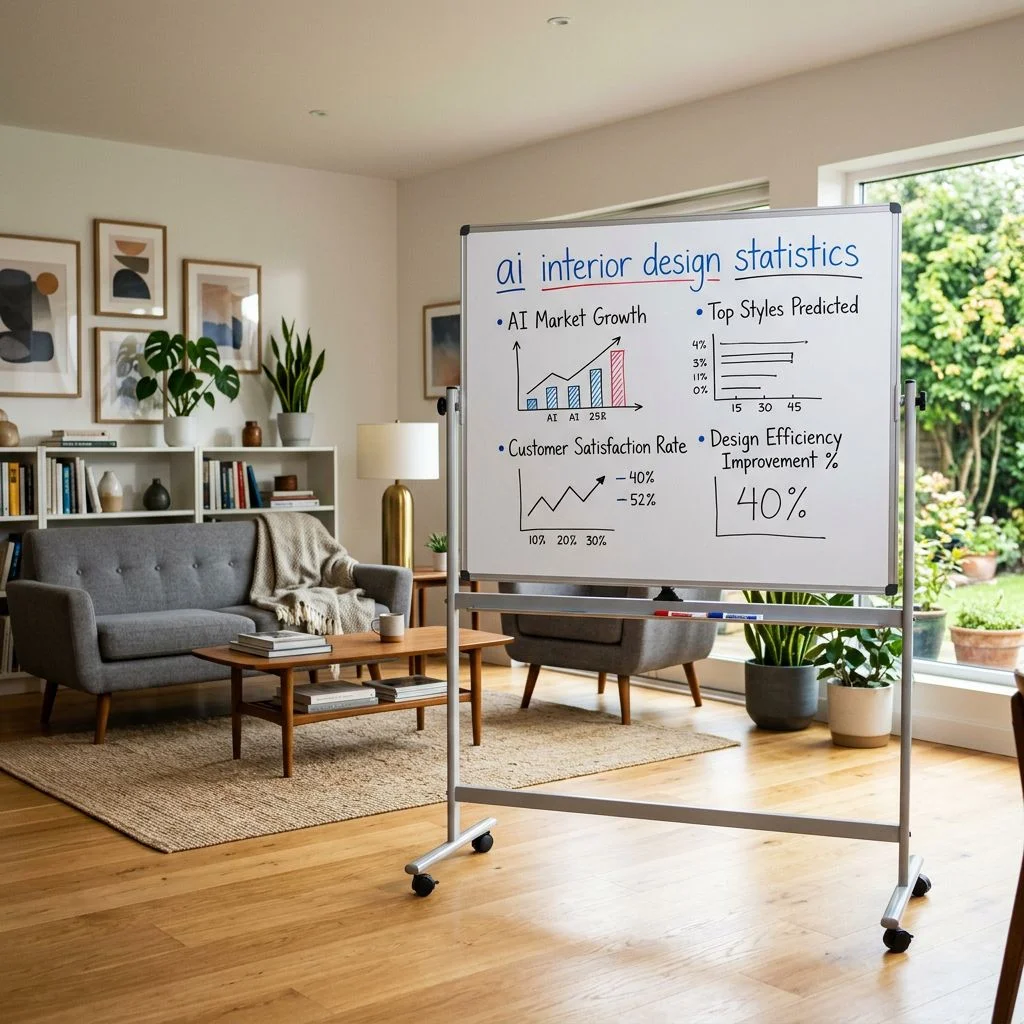
AI interior design has moved from a novelty into an actual software category in just a few years. In 2026, designers are using it to concept faster, sellers and agents are leaning on virtual staging to make listings stand out, and buyers are actively prioritizing immersive visuals before they ever step inside a home. Below are 10 AI interior design statistics you should know this year, covering market size, designer adoption, and the measurable impact that visualization and staging have on real-world outcomes.
The Stats
According to Grand View Research, the global AI in interior design market was estimated at $3.28 billion in 2025 and is projected to reach $15.0 billion by 2033.
This is the cleanest “category exists at scale” number in the space. A ~4.5x jump over eight years doesn’t happen to a gimmick — it happens to a software segment that’s actively replacing manual work. For interior design specifically, that growth is tied to three things: generative image models getting good enough for client-facing concepts, real estate workflows adopting virtual staging as a norm, and homeowners doing pre-purchase visualization on their own before hiring anyone.
The deeper signal is that AI interior design is no longer competing with “free tools on your phone.” It’s competing with traditional services — photographers, physical staging companies, mood-board decks, and renderings — which is where the real spend is. That’s why the market opportunity is much bigger than most people assume from the consumer-facing surface.
What it means: AI interior design is a real software category, not a feature trend — and the budget moving into it is coming from services, not toys.
The 2025 U.S. Houzz State of AI in Construction & Design found that 31% of design businesses already use AI, and that number rises to 50% among firms with 10 or more employees.
This is the “it’s not early adopters anymore” statistic. When a third of the entire industry has already adopted a tool, and half of the mid-sized and larger firms are using it, AI has crossed from curiosity into operational workflow. The scale correlation is the important part: bigger firms usually move slower, so when they’re adopting faster than the industry average, it means AI is solving something painful enough to push through internal inertia.
It also means smaller firms and solo designers are now in an unusual spot. Historically, bigger firms had an edge because they could afford more renderers, more junior designers, and faster turnaround. AI collapses a lot of that advantage. A good AI interior design tool lets a one-person studio produce concept visuals at a quality and speed that used to require a team.
What it means: AI has crossed into mainstream industry use, and the firms still resisting it are the ones most likely to feel squeezed next.
The same Houzz report estimates that AI-using design firms gain about $74,400 in annual productivity per firm.
This is a headline-grabbing number, and it deserves a little context: it’s modeled from self-reported time savings, not audited financials. So it’s better read as “AI is recovering meaningful hours” than “AI deposits $74k in your account.” But the directional point is real — the time spent on concept iterations, client revisions, mood boards, and early-stage renderings is exactly the kind of work that AI compresses by an order of magnitude.
The practical takeaway for solo designers and small studios is that this productivity doesn’t have to show up as “more clients.” It often shows up as faster turnaround, more revisions per client, fewer late nights, and bigger margins on the same scope. That is often a more honest framing of AI’s ROI than a raw dollar figure.
What it means: AI’s real win for design firms is time, and time is where profitability actually hides.
A 1stDibs designer survey shows that AI use among interior designers tripled to 29% in 2025, up from 9% in 2023.
A 3x jump in two years is the kind of adoption curve you usually see when a tool goes from “interesting experiment” to “normal part of the workflow.” That’s what’s happening with AI in interior design. The tools got good enough for actual client work — not just idea sparks — and designers started using them for concepting, style exploration, and AI room redesign without needing to explain themselves.
What makes this stat particularly credible is that it comes from a designer-specific sample, not a general “people who tried AI once” panel. These are working professionals, and their adoption curve is steeper than most consumer tech trends. If that pace holds for even one more year, AI goes from a third of designers to a clear majority — which changes the default expectations clients have when they hire a designer at all.
What it means: AI adoption inside the design profession is accelerating, not plateauing — and client expectations will follow.
A 2025 industry survey covered by Kitchen & Bath Design News found that 71% of designers say AI can boost creativity.
This statistic pushes back on the most common fear in the industry: that AI is a creativity killer. The designers actually using these tools aren’t reporting that they feel replaced or flattened — they report that AI expands their range. It lets them try more styles, test ideas before committing, and show clients options that would be too expensive or too slow to mock up manually.
The honest nuance here is that AI doesn’t generate taste. It generates options. The designer still has to know what’s good, what fits the client, and what belongs in the final room. But being able to skip from “blank page” to “twelve credible directions” in a few minutes is a genuine creative accelerant — especially for early-stage concepting or when a client is stuck between two vibes.
What it means: The designers using AI aren’t afraid of it — most of them say it makes their creative process better, not smaller.
According to Zillow's 2024 Consumer Housing Trends Report, 71% of sellers say they are more likely to hire an agent who includes virtual tours and/or interactive floor plans.
This is one of the most commercially important stats in the entire set. It doesn’t just say “virtual tours are nice.” It says sellers use visualization as a filter when choosing who they’ll trust with their biggest transaction. That makes listing visuals a business development tool for agents, not just a marketing afterthought.
For real-estate-facing use cases, this is where AI virtual staging earns its keep. You don’t need to rent physical furniture, book a photographer twice, or coordinate a staging crew to walk into a listing meeting with a visual story. You can stage vacant rooms in seconds and show up to the pitch with something most competing agents still don’t bring.
What it means: Visualization isn’t just listing decoration — it’s a signal sellers use to pick their agent in the first place.
Zillow's 2025 Prospective Buyers report found that 20% of prospective buyers rank a 3D/virtual tour as the single most important listing feature.
Ranking first is a high bar. Buyers are saying that — out of every field on a listing page — immersive visuals are the element most likely to decide whether they engage. Floor plans still lead at 33%, but the fact that 3D tours now sit in the top tier alongside them is the story. Immersive media went from “bonus content” to “deciding factor” in just a few years.
For sellers and agents, the implication is blunt: a vacant or poorly presented room is a tax on the listing. A clean, staged visual — especially one that helps a buyer mentally place their own life in the space — directly competes for attention with every other listing in the feed. An empty room generator is useful precisely because it can turn a barren photo into a credible future home without a rental truck.
What it means: Immersive visuals aren’t a differentiator anymore — they’re a table-stakes expectation for modern buyers.
The National Association of REALTORS 2025 Profile of Home Staging found that 83% of buyers' agents say staging makes it easier for a buyer to visualize the property as a future home.
This is the clearest “why visualization works” stat in the whole dataset. An empty room is a floor plan — a staged room is a possibility. The mental leap between those two is exactly the leap that turns a casual browser into an engaged buyer. 83% agreement from agents who watch this happen in person is a much stronger signal than any marketing claim.
The reason this matters for AI is that traditional staging is slow and expensive. It’s worth it for premium listings, but it disqualifies a lot of properties on cost alone. AI virtual staging pushes the same psychological effect — “I can see myself living here” — onto listings where physical staging was never going to happen. That expands the benefit to the middle of the market, not just the top of it.
What it means: Staging works because it unlocks imagination, and AI makes that unlock available at every price point.
The same NAR report found that 31% of buyers are more willing to walk through a home they saw online after seeing it staged.
This is the conversion stat. Staging doesn’t just look nicer — it changes behavior. Almost a third of buyers say it’s the reason they’ll take the next step and physically show up. In a world where the biggest friction in real estate is getting someone from their phone to a front door, that’s a huge number.
The takeaway for anyone in real estate is that listing visuals are doing real funnel work. A well-staged photo is not just prettier; it actively pulls more showings. And because AI staging is fast and inexpensive, it makes that lift available on listings that historically would’ve gone to market empty. That’s where a furniture visualizer earns its keep — it collapses the gap between “photo went up” and “feet through the door.”
What it means: Staged visuals move buyers from browsing to showing, and that’s the conversion step that actually drives deals.
An academic paper published in Housing Studies found that VR tours shortened property marketing time by 6.4% and narrowed bid-ask spread by 2% in residential real estate.
This one is special because it’s not an opinion survey — it’s an outcome-based result from transaction data. Homes marketed with immersive visuals sold faster and closer to asking price. Those are the two numbers that matter most to sellers and agents, and this paper measured both.
The implication for AI interior design is that immersive and staged visuals aren’t just about engagement metrics — they show up in the actual closing table. Shaving days off marketing time and points off negotiation spread translates into real money. A tool that lets you see your room before you spend on it provides the same psychological mechanism to homeowners, designers, and agents alike: reducing the uncertainty that slows decisions down.
What it means: Immersive visualization changes actual market outcomes, not just clicks — and that’s the rarest and most defensible kind of evidence in this space.
Closing Thoughts
AI interior design is officially mainstream in 2026. The data tells a consistent story: the market is scaling, designers are adopting AI faster than almost any other profession of their size, and visualization — whether as staging, virtual tours, or AI-generated redesigns — measurably changes how buyers, sellers, and homeowners make decisions. The practical takeaway is simple: if you’re a designer, AI is a creativity and productivity multiplier. If you’re an agent or seller, immersive visuals are the difference between a listing that scrolls past and a listing that gets a showing. And if you’re a homeowner, being able to preview a room before you commit is one of the fastest ways to avoid expensive mistakes.